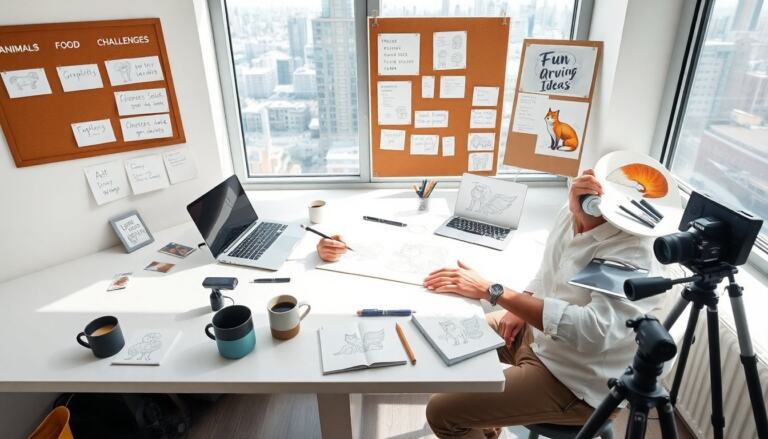

Sketches drawing ideas easy help a beginner start fast and stay consistent. The list below gives clear prompts, short step sequences, and variations so each session feels purposeful. Prompts are chosen for common availability—cup, leaf, eye, rock—so you can draw almost anywhere with minimal tools. The emphasis is on repeating focused, low-pressure exercises that train seeing, simplify complex forms, and gradually increase confidence. Over weeks, these small sketches compound into noticeably improved observation, line control, and proportion skills.
Key Takeaways
- Easy sketches drawing ideas help beginners build core skills quickly through short, focused practice sessions.
- Using simple everyday objects and nature prompts encourages daily sketching habits that fit into busy schedules.
- Repeating the same sketch multiple times builds confidence and improves accuracy in drawing proportions and details.
- Step-by-step mini exercises guide artists to observe, block shapes, add details, and refine their sketches efficiently.
- Practicing simple people and face sketches with loose lines enhances understanding of gesture and proportion without pressure.
- Varying line weight, mark speed, and viewpoint adds depth to simple studies without lengthening sessions.
Why Simple Sketches Improve Your Drawing Fast
Simple sketches drawing ideas easy let a person practice core skills daily because they reduce setup, decision fatigue, and fear of failure. Short, repeated exercises force focus on shape, line, and proportion instead of getting lost in detail. The brain learns patterns from repeated, small drawings—edges, joints, planes—so you start recognizing them automatically. Simple subjects encourage experimentation with line weight, hatching, and mark-making, which quickly reveals what improves legibility and volume.
Because sessions are brief, you can fit multiple short practices into a week: five 10–20 minute sessions outperform one long session for most beginners. Variety in prompts prevents habit stagnation while repeating the same subject several times in one session accelerates correction of recurring mistakes. Simple sketches also lower the stakes: when accuracy isn’t the only goal you’ll explore gesture, proportion, and rhythm more freely. Over time these small, frequent wins translate into stronger compositional choices and faster rendering skills.
Everyday Object Sketch Ideas (5 Fast Prompts)
- Cup: Draw a simple cup from three angles. Start with the rim ellipse, then the body and handle. Try a quick tonal wash or cross-hatching to indicate inside shadow.
- Keys: Draw the key shapes and overlaps. Focus on silhouette and how metal bends light—use a single heavier line for the outer edge and lighter internal lines for teeth.
- Glasses: Draw frames and reflections. Block the major shapes first, then add lenses and catchlights; practice one-eyed and both-eyed views.
- Watch: Draw the circle, band, and numbers. Simplify hands to lines and mark major markers; explore foreshortening by drawing the band in perspective.
- Plant pot: Draw the pot, soil line, and leaf shapes. Observe how leaves overlap and cast shadows on the rim; vary marks to show texture for clay vs. ceramic pots.
Practice tips for these prompts: limit each sketch to 10–20 minutes, repeat the same object three times with a different focus each pass (gesture, structure, detail), and switch tools occasionally—pencil, pen, charcoal—to discover what helps you see edges versus texture. Common beginner traps: overworking the rim of rounded objects, ignoring ellipses, and drawing outlines too heavy; correct these by starting with light construction lines and committing darker lines at the end.
Nature And Outdoors Sketches (5 Easy Prompts)
- Leaf: Draw the outline and central vein. Practice varying scale and orientation; capture asymmetry and small tears to make leaves believable.
- Rock: Draw simple contours and flat planes. Observe how light splits a form into planes—render with broad strokes or simple hatching to show volume.
- Tree trunk: Draw bark texture and cross-sections. Start with the trunk’s major gesture, then add rough, rhythmic marks to suggest bark without detailing every fissure.
- Cloud: Draw soft edges and volume. Use minimal lines to suggest layers; focus on the silhouette and negative space beneath the cloud.
- Flower: Draw petals and center shapes. Block the center first, then indicate petal rhythm; try three quick sketches changing viewpoint each time.
When working outside, set a timer and accept imperfect conditions—wind, moving subjects, changing light—this trains quick decision-making. Use thumbnail sketches to explore composition and scale before committing to a larger page. For texture studies (bark, rock), try making three marks per surface type to build a personal shorthand for these materials.
People And Faces Made Simple (5 Beginner Prompts)
- Profile: Draw a side view with one line for the face. Capture the overall head shape and jawline, then add major planes (forehead, nose, chin).
- Eyes: Draw eyes in three expressions. Focus on basic ovals, eyelid arcs, and the pupil position; show how small shifts create different emotions.
- Hands: Draw a relaxed hand and a fist. Start with simple block shapes for palm and fingers, then refine proportions and joint bends.
- Silhouette: Draw simple body shapes in motion. Ignore internal detail and focus on gesture line and weight distribution to convey movement.
- Head tilt: Draw three tilt angles. Use a center line for orientation, then place features relative to that line; this trains perspective on the face.
For people studies, prioritize gesture and proportion over detail. Work from short timed poses (30–90 seconds) to long 5–10 minute studies and notice which errors persist—usually ear placement, jaw angle, or shoulder width—and adjust the construction lines. Avoid getting stuck erasing; instead, make a new drawing and apply the correction. Practicing faces and hands this way makes sketches drawing ideas easy while building the most challenging skills in approachable steps.
Step-By-Step Mini Exercises For Each Prompt
Step 1: Observe the subject for 30–60 seconds—note overall rhythm, major angles, and high-contrast areas. Step 2: Block main shapes with light lines or simple geometric forms (ovals, rectangles, cones). Step 3: Add one detail per pass—rim, vein, eye, finger—so each iteration has a clear purpose. Step 4: Refine edges and correct proportions; darken confident lines and reduce visual noise. Step 5: Stop and compare the sketch to the subject, then make a short note about one thing to improve next time.
Structure a session by doing three quick passes of the same prompt: pass one for gesture, pass two for structure, pass three for a focused detail. Track progress by keeping sketches dated and noting recurring mistakes to target in future sessions. The mini exercises make sketches drawing ideas easy to repeat and measure, helping you turn brief practice into steady improvement without overwhelming time commitments.