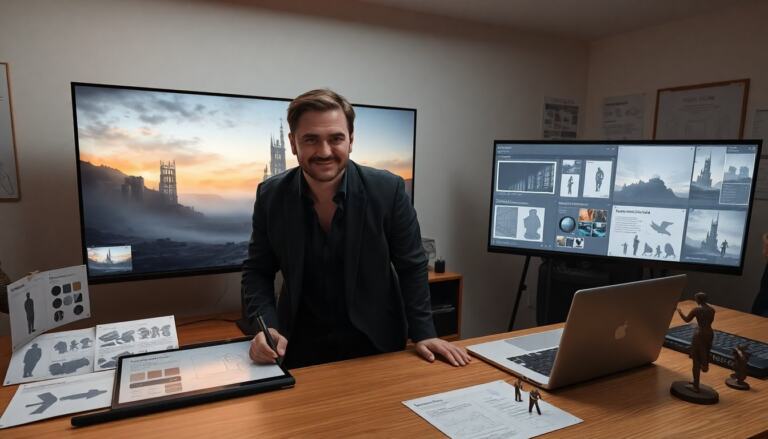

Fantasy concept art serves as the first step in making a game, film, or book feel real. The artist sets mood, defines scale, and suggests story with a few strong visuals. This guide shows clear steps for research, design, and rendering that help teams and solo artists produce usable, polished concept art.
Key Takeaways
- Fantasy concept art is essential for visually defining a project’s mood, style, and story before production starts.
- Effective fantasy concept art relies on thorough research and organized visual references to maintain originality and consistency.
- Starting with silhouette designs helps artists create clear, readable character and creature concepts that match their roles and world rules.
- Environment and prop designs should reflect cultural and social details while maintaining consistent scale and guiding the viewer’s focus.
- A structured workflow using thumbnails, iteration, and non-destructive layers speeds up production and improves the quality of fantasy concept art.
- Incorporating material details and narrative hints in final renders enhances believability and aids production teams in using the art effectively.
Understanding Fantasy Concept Art: Purpose, Genres, And Core Elements
Fantasy concept art shows ideas before production begins. It gives clients and teams a visual plan. The art defines style, culture, and rules for a project. Common genres include high fantasy, dark fantasy, low-magic fantasy, and urban fantasy. Each genre requires different costume, architecture, and color choices. Core elements include silhouette, scale, gesture, palette, and visual story. The artist picks one clear idea to show per piece. The artist uses contrast and composition to guide the viewer. The art must answer: who lives here, what matters, and what can change.
Beyond immediate visuals, fantasy concept art functions as a communication tool between departments: art direction, environment, animation, VFX, and narrative. Good concept art anticipates production constraints by indicating plausible materials, modular construction, and clear proportions for rigging and modeling. It also anchors tone—whether a scene feels mythic, gritty, whimsical, or uncanny—using lighting, color temperature, and symbolic motifs.
When choosing a genre or subgenre, note how conventions influence design decisions. High fantasy often favors sweeping silhouettes, ornate costumes, and a heroic color palette, while dark fantasy uses compressed palettes, gritty textures, and ambiguous morality cues. Urban fantasy blends contemporary architecture with subtle fantastical elements, which affects scale and the level of detail needed to read the magic in a modern context.
Research, Worldbuilding, And Visual Reference Strategies
Research grounds fantasy concept art in believable detail. The artist gathers historical, cultural, and material references. The artist studies architecture, textiles, and natural forms that match the intended setting. The artist records rules for magic, technology, and society in short notes. The artist tests those rules with quick sketches to check consistency. The team collects images, color samples, and short written briefs. The artist keeps references organized by theme, not by random folders. The artist reviews references often to avoid copying exact designs and to keep ideas original.
Effective reference strategies include building mood boards that separate visual inspiration by category—architecture, costume, color, props, and flora/fauna—so each design decision can be justified. Use annotated references: mark which element you want to borrow (a roofline, a stitch pattern, a joint type) and why it fits the world’s rules. Keep a short worldbuilding bible with bullet points on resources, climate, trade, and taboos; these constraints generate believable variation and inform material choices.
Balance inspiration and originality by combining disparate references to create new hybrids (for example, a coastal palace that borrows structural solutions from real-world maritime architecture, then overlays fantastical ornamentation). When researching creatures, study biomechanics and ecological niches to make hybrids that would plausibly move and survive in that world. Finally, maintain a revision history for reference sheets so teams can trace which brief informed each concept and avoid scope creep.
Designing Characters, Creatures, And Costumes: From Idea To Silhouette
Design starts with silhouette in fantasy concept art. The artist blocks shapes to test readability at a distance. The artist uses thumbnails to try many silhouettes quickly. The artist selects a silhouette that matches character role and personality. The artist refines shapes into costume elements and functional gear. The artist checks that gear answers practical needs for the world rules. For creatures, the artist studies anatomy and combines traits to suggest believable motion. The artist uses color and texture to signal habitat and danger. The artist adds small worn details to show past use and story.
A practical approach: begin with dozens of 30–60 second thumbnails focusing strictly on silhouette and gesture—no details. Group silhouettes by role (tank, scout, magic-user) and pick the strongest three to iterate. When moving to detail stage, ask functional questions: how does armor attach without modern fasteners? Where does a mage carry components? How do cultural values show in decoration or scars? Use accessory design to show occupation, rank, or origin without overly complex anatomy.
Creature design benefits from anatomical study and believable adaptations: consider center of mass, limb articulation, feeding strategy, and sensory organs. Costume design should prioritize clear shapes and silhouette over surface detail; texture and ornament come later to support narrative. Use color theory intentionally—opposite hues to create focus, desaturated palettes for background characters, and saturated accents for protagonists. Finally, create turnaround sketches and expression sheets when a design moves into production to aid modelers and animators.
Environment, Prop, And Architectural Design For Fantasy Settings
Environment design sets scale and mood in fantasy concept art. The artist sketches quick layouts to choose focal points. The artist decides how architecture reflects culture, power, and materials. The artist designs props that reveal daily life and social order. The artist keeps prop scale consistent across all pieces. The artist uses layers to separate foreground, midground, and background. The artist places landmarks that guide the eye and the player. The artist creates modular elements for faster iteration and reuse. The artist tests how structures feel from multiple camera angles to ensure clarity.
Start environments by establishing primary silhouettes of major structures and landmarks, then test readability at thumbnail scale. Consider circulation—how people move through the space—and place props to suggest routes, workspaces, and ritual zones. For architecture, define construction methods (post-and-beam, stone vaulting, biomaterial fusion) and let those methods drive recurring forms and detail language. Props are storytelling tools: a broken banner, a well-worn tool, or a ritual object can reveal history and social hierarchy.
Practical tips: design modular sets of elements (arches, doors, stair modules) so assets can be recombined for multiple scenes; this saves time and creates visual cohesion. Test lighting scenarios—day, dusk, torchlight—to ensure silhouettes still read and key narrative elements remain visible. Add small human or creature figures early to confirm scale. Finally, create a materials cheat sheet that defines surface behavior (reflectivity, roughness, paint wear) so painters and texture artists maintain consistency across teams.
Workflow And Tools: Thumbnails, Iteration, And Final Render Techniques
A clear workflow speeds production of fantasy concept art. The artist starts with many thumbnails to explore ideas. The artist narrows options to two or three directions for approval. The artist builds a block-in stage to set proportions and perspective. The artist refines forms, then applies base color and local values. The artist adds material details and small narrative elements last. Common tools include sketching tablets, layered files, and color systems. The artist uses non-destructive layers and separate files for version control. The artist keeps final renders at usable sizes and includes turnarounds and texture notes for production teams.
Refine your process by setting checkpoints: research and mood board, 6–12 thumbnails, 2–3 refined comps, color pass, detail pass, and delivery package (turnarounds, orthos, prop sheets, texture callouts). Use versioned filenames and a short change log so art directors can track decisions. For software, take advantage of non-destructive workflows—layer masks, adjustment layers, and smart objects—to speed iteration and allow quick stylistic shifts without reworking base painting.
Rendering tips for final polish: focus first on readability of values, then on color harmony, and finally on material detail. Use edge control to direct attention—sharper edges in focal areas, softer edges in peripheral zones. Add subtle environmental effects (dust, moisture, bloom) to sell atmosphere but keep them restrained to avoid muddying forms. Always include export notes for production (resolution, aspect ratio, palette swatches, and any animation or modeling constraints). A well-documented final file makes fantasy concept art actionable, saving production time and reducing ambiguity in later stages.