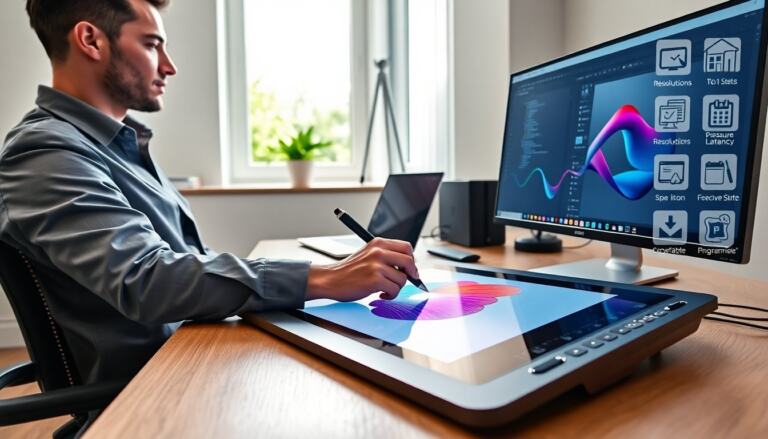

In 2026, understanding the main types of digital art helps creatives choose the right tools and workflows for a project. The landscape mixes traditional painting techniques, code-driven generation, and real-time 3D pipelines, each suited to different goals from illustration to interactive experiences. This guide outlines the major categories, how they differ, and where they’re most useful.
Key Takeaways
- Raster art excels in detailed digital painting but lacks scalability, while vector art offers infinite scalability for crisp graphics like logos and icons.
- Pixel art uses a low-resolution grid for a nostalgic, stylized look popular in indie games and sprites.
- 3D modeling, digital sculpting, and photoreal rendering each serve different needs from animation-ready meshes to intricate organic detail and lifelike imagery.
- Generative, AI, and algorithmic art combine computation and rules to create visuals, balancing creativity with technical skill and ethical considerations.
- Motion, animation, VFX, and AR/VR bring digital art to life with storytelling, immersive experiences, and real-time interactivity across 2D, 3D, and mixed media platforms.
Raster, Vector, And Pixel Art — Painting, Illustration, And Sprites
Raster art is built from pixels and is the go-to for digital painting and photo editing. Programs like Photoshop and Procreate let an artist work with brushes, layers, and textures: raster files (PNG, TIFF) capture subtle color gradations but lose quality when scaled up. Raster fits concept art, matte painting, and any work that benefits from painterly detail.
Vector art uses mathematical paths rather than pixels. Tools such as Adobe Illustrator and Affinity Designer produce infinitely scalable graphics ideal for logos, icons, and print. Because vectors store shapes and curves, they’re perfect when crisp edges and scalability matter, for example, branding or large-format posters.
Pixel art intentionally embraces the grid, creating images at low resolutions for a retro aesthetic. Popular in indie games and sprite-based animation, pixel art requires careful placement of colored pixels and palette management. It’s compact, expressive, and often used where restricted resolution or nostalgic styling is desired.
Common trade-offs: raster equals rich detail but limited scalability: vectors scale perfectly but can look flat for painterly subjects: pixel art sacrifices smoothness for stylized clarity. Artists pick the format based on final output, whether print, web, or game engine integration.
3D Modeling, Digital Sculpting, And Photoreal Rendering
3D modeling constructs objects from meshes and is foundational for animation, product visualization, and game assets. Software like Blender, Maya, and 3ds Max focuses on polygonal modeling, UV mapping, and topology, critical when models must deform for animation or run efficiently in real-time engines.
Digital sculpting (ZBrush, Blender Sculpt) treats geometry like virtual clay. Artists sculpt high-resolution detail, pores, fabric folds, and organic anatomy, that can be baked into normal maps for use in real-time models. Sculpting shines when intricate surface detail and expressive forms are required.
Photoreal rendering combines models, materials, lighting, and camera settings to produce lifelike images. Render engines (Cycles, V-Ray, Arnold) simulate light to achieve realistic reflections, shadows, and depth of field. Photoreal work suits advertising, architecture, and VFX where believable imagery is the primary goal.
Key considerations: modeling plus efficient topology for animation: sculpting for high-fidelity organic detail: and rendering choices depending on whether the target is real-time performance or cinematic quality. Each stage often feeds the next in a pipeline that goes from blockout to textured, lit final image.
Generative, AI, And Algorithmic Art (Procedural, Neural, And Code-Based)
Generative and algorithmic art uses rules, randomness, and computation to produce visuals. Procedural methods (used in Houdini, Substance Designer, and shader code) generate textures, terrains, and complex systems without manually modeling every detail, great for large-scale scenes and game worlds.
Neural or AI-assisted art leverages machine learning models to create or transform images. Artists use diffusion models, style transfer, and custom networks to explore new aesthetics, iterate concepts quickly, or generate textures. While powerful, these tools require careful curation and an understanding of model limitations and ethical considerations.
Code-based art (Processing, p5.js, TouchDesigner) gives creators fine-grained control over form through algorithms. It’s common in generative installations, data visualization, and live visuals. These methods prioritize variability and responsiveness, outputs can change every run or respond to inputs like sound or user interaction.
Strengths and caveats: generative approaches scale production and introduce novel patterns but often need technical knowledge. AI tools accelerate ideation but raise questions about authorship and provenance. For many studios, combining procedural systems with artist-led refinement yields the best balance of efficiency and control.
Motion, Animation, And Mixed‑Media Composites (VFX, Motion Graphics, AR/VR)
Motion and animation bring digital art to life through timing, rigging, and keyframes. 2D animation (spine, After Effects) and 3D animation (Maya, Blender) require different skill sets: 2D focuses on frame timing and stylistic motion: 3D adds rigging and physics. Motion graphics combine design, typography, and animation for explainer videos and broadcast content.
VFX and compositing merge rendered and photographed elements. Tools like Nuke and After Effects let artists integrate CG into live footage, add particle effects, and match lighting, essential for film and commercials. Mixed-media compositing often involves color grading and rotoscoping to achieve seamless results.
AR/VR expands digital art into immersive spaces. Artists must optimize assets for performance and design interactions for presence. Real-time engines (Unreal, Unity) enable interactive installations, spatial storytelling, and experiential advertising.
When to choose motion/mixed media: pick animation for narrative and timing, motion graphics for information-rich visuals, VFX for film-grade integration, and AR/VR for immersive, interactive experiences. Each discipline borrows techniques from the others, so cross-disciplinary fluency is increasingly valuable.
Types of Digital Art: Frequently Asked Questions
What are the main types of digital art used in creative projects?
The main types include raster art for detailed digital painting, vector art for scalable graphics, pixel art for retro-style images, 3D modeling and sculpting for realistic objects, generative and AI art for algorithmic designs, and motion or mixed-media composites for animation and immersive experiences.
How does raster art differ from vector art in digital creation?
Raster art is pixel-based, ideal for painterly detail but loses quality when scaled, while vector art uses mathematical paths for infinite scalability and crisp edges, perfect for logos, icons, and print materials.
What are the benefits of using generative or AI art in digital workflows?
Generative and AI art methods accelerate production, create novel patterns, and enable quick concept iterations. However, they require technical skill, careful curation, and consideration of ethical issues like authorship and provenance.
When should an artist choose motion graphics over 3D animation?
Motion graphics are best for information-rich visuals like explainer videos, combining design and typography, while 3D animation focuses on rigging, physics, and lifelike movement suited for narrative storytelling and detailed character animation.
What software is commonly used for 3D modeling and digital sculpting?
Popular 3D modeling tools include Blender, Maya, and 3ds Max for polygonal modeling, while digital sculpting often uses ZBrush and Blender Sculpt to create high-resolution organic details.
How does pixel art differ from other digital art types, and where is it commonly used?
Pixel art embraces a low-resolution grid aesthetic with carefully placed pixels and limited color palettes, often used in indie games and sprite animations to evoke a nostalgic or retro style.